- Home
- Experiences
- Greece
- Greek Islands
- Hidden Treasures of Crete - 5 days on Sundays
TourHidden Treasures of Crete - 5 days on Sundays
Tour location:Greek Islands
From R$9,048.76 /person


Day 1
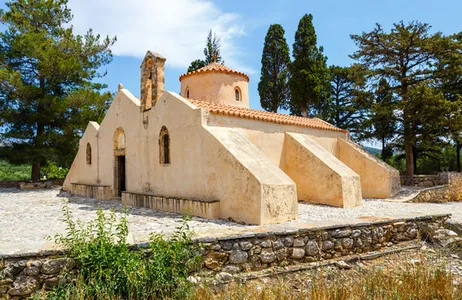
The tour begins along the island's northern coastal road, where we will visit the 12th-century Byzantine church of Panagia Kera, located 1 km from the village of Kritsa. The church houses the best-preserved Byzantine frescoes in Crete and, for this reason, is considered one of the most culturally and historically important churches on the island.
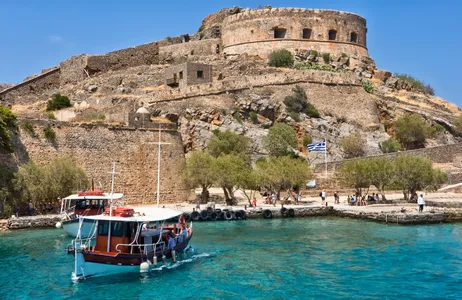
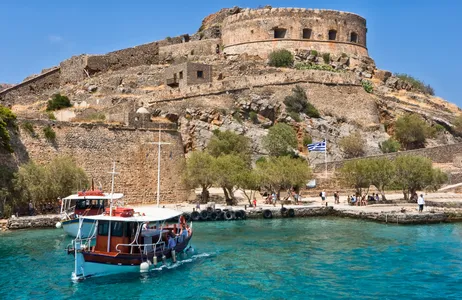
We continue our journey along the beautiful coastal road and through the village of Elounda, located 11 km north of the city of Agios Nikolaos. Elounda maintains its authentic character and offers a unique landscape with many coves and preserved beaches. One of these is the coastal village of Plaka, from where we will embark on a boat to the now uninhabited island of Spinalonga. Our guide will lead us through the ruins of what was a leper colony between 1903 and 1957, where patients could have a better life with medical assistance and economic support.
After visiting Spinalonga, there will be free time for swimming in the crystal-clear waters of Plaka and an optional lunch at Taverna Spinalonga (Plaka). Next, we will visit the town of Agios Nikolaos, capital of the Lassithi region. There, the salt lake Voulismeni, with its vast horizon, dominates the landscape. A narrow channel connects the lake to the sea, while an imposing backdrop of reddish rocks and trees contributes to the natural beauty of the place. A small pine park stretches above the lake, and a stone path leads to its southern end, where there is a small and charming harbor for fishing boats.
The city boasts interesting museums of archaeology, folklore, and natural history, Byzantine churches, a well-organized marina, bustling pedestrian streets (ideal for leisurely strolls), and traditional squares with lively cafes and restaurants.
In the late afternoon, at 6 PM, return to Heraklion. Dinner and overnight stay at the hotel.
Day 2
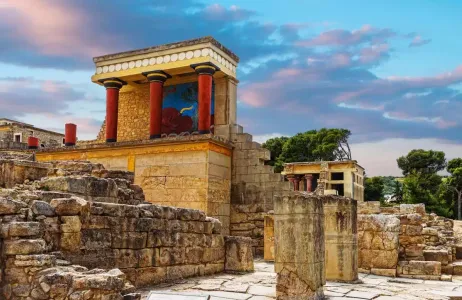
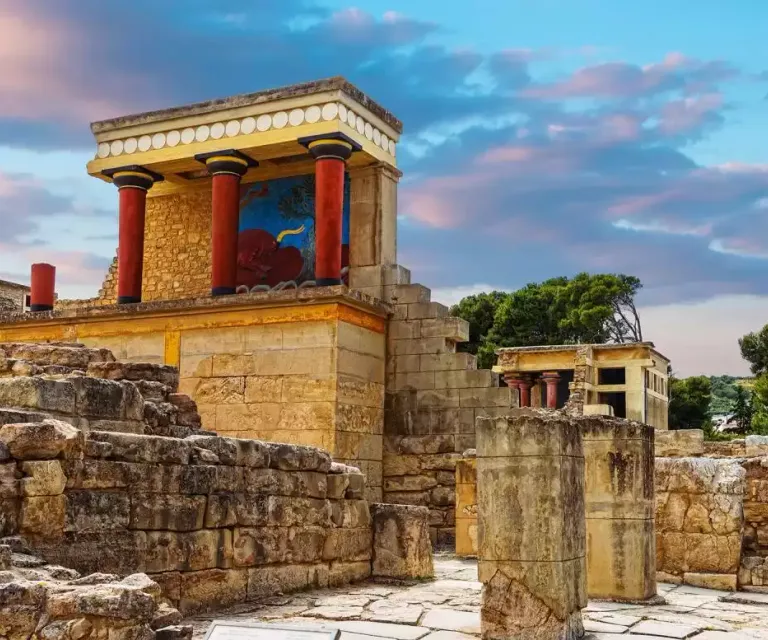
After breakfast at the hotel, your guide will take you at 8:30 am to the Palace of Knossos, the largest Minoan palace, built between 1700 and 1400 BC. The palace displays advanced architectural techniques, with areas reaching up to five stories. The first settlements in Knossos date back to the Neolithic period, around 7000 BC.
During the visit, we will explore approximately 1,300 rooms, corridors, storage areas, and a theater, learning about the ancient Minoan civilization. The archaeological site was discovered in 1878 by Minos Kalokairinos, and excavations began in 1900 under the direction of Sir Arthur Evans, extending for more than 35 years.
Around 11:30 am, I returned to Heraklion to visit the Heraklion Archaeological Museum, the second largest in Greece after the National Archaeological Museum of Athens. Its collection includes the oldest finds from Crete, dating back to 6000 BC, important pieces from the Minoan palaces of Phaistos, Malia, and Zacro, as well as artifacts from cemeteries, sanctuaries, and residences, culminating in the famous Minoan frescoes of Knossos.
After the visit, return to the hotel at 1:30 PM. Dinner and overnight stay at the hotel.
Day 3
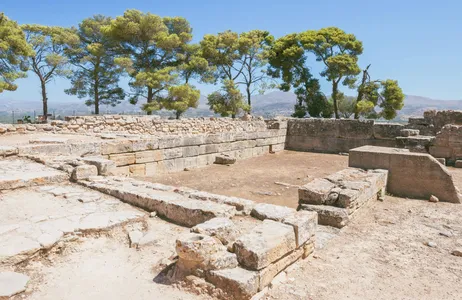
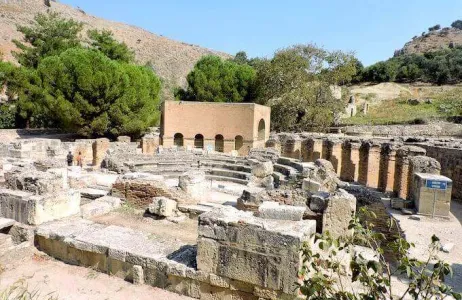
After breakfast at the hotel, around 8:30 am, we departed for Gortyna, the Roman capital of Crete and Cyrenaica, first inhabited around 3200 BC. After visiting Gortyna, we crossed the Messara Valley to see the archaeological site of Phaistos and its palace, the most important center of the Minoan civilization and the richest and most powerful city in southern Crete.
After visiting Phaistos, we will continue to Matala, where there will be free time to swim in the crystal-clear waters and have lunch. Next, we will arrive in Zaros, a charming and well-preserved village, famous for its spring water—now bottled and sold throughout Greece—and an excellent base for nature walks. Zaros also boasts beautiful Byzantine monasteries and is known for its delicious trout raised on local farms, served in the village taverns and around Lake Votomos, with its emerald-green waters, which we will visit.
Overnight stay at the hotel.
Day 4
Breakfast at the hotel in Zaros. Around 9:30 am, we depart for the traditional Cretan village of Vatos, a small village hidden amidst the vegetation, where we find all the elements of local tradition. Walking through its narrow streets, we visit the old school, its fountain, and the museum with tools and agricultural implements from times past.
We concluded our visit at the village's caldera, where Raki, the famous alcoholic beverage of Crete, is produced.
Our next stop is Spili, known for its Venetian fountain with a long row of 25 lion heads carved in stone, from whose mouths fresh water gushes. Optional lunch in Spili.
Next, we visited Lampini, its church, and the Panagia Museum. The church has a dome and frescoes from the 12th and 14th centuries. It was an episcopal church, as the village of Lampini housed the seat of the famous Bishopric of Lampis, which existed since the year 431.
We continue on to the Santo Antônio Canyon, where we will hike along a beautiful trail, surrounded by lush vegetation, to the Santo Antônio Grotto.
Dinner and overnight stay at the hotel in Rethymno.
Day 5
Breakfast at the hotel in Rethymno. Around 9:30 am, we will begin the tour with our first stop in Margarites, a small traditional village located in the Rethymno region, known for its unique pottery tradition, picturesque alleyways, and well-preserved architecture.
Next, we visited the Arkadi Monastery, an important architectural and cultural landmark, notable for its magnificent facade, strong spiritual tradition, and flourishing fine arts. The Holocaust of 1866 gave the monastery a prominent place in history, making it an enduring symbol of freedom and heroism, recognized worldwide.
Our final stop is Rethymno, one of the best-preserved medieval cities in Greece and one of the most beautiful in Crete. We will visit the charming historic center and there will be free time for lunch (optional). Afterwards, we will visit the Fortezza Veneziana, built atop Paleokastro hill between 1540 and 1570 as a fortification against Turkish pirates. More than 100,000 Cretans, in forced labor, and more than 40,000 pack animals were used in its construction. The fortress was conquered by the Turks in 1646 and, after centuries of transformations, only the outer fortifications remain intact, with some buildings still under restoration. The Fortezza is visible from all over the city and offers a panoramic view of Rethymno. The entrance is through the East Gate, via an imposing arch.
After the visit, we continue along the north coast of the island, along the Cretan Sea, passing the coastal villages of Bali, Fodele and Agia Pelagia, until we reach Heraklion, where the tour ends at 6 pm at the Cretan Spiti Travel terminal.
Encontro com o guia no terminal da Cretan Spiti Travel, em frente à entrada do Museu Arqueológico de Heraklion, em frente à Hari’s Creperie, em Heraklion, às 08h30
Doubt or unforeseen? Send a message via Chat.
Check the discounts according to each experience.
5 days
Regular tour
Available
Matches: every Sunday
Duration: 5 days / 4 nights
3rd adult: 10% discount